Your phone rings. Unknown number, Joburg area code. You look at it, you let it ring, and if it matters they’ll leave a message or send a WhatsApp. You didn’t even think about it.
Everyone you know does the same thing. That reflex, which almost all of us developed in the last two or three years without discussing it, has quietly killed one of the oldest ways of finding customers in this country.
The numbers behind the reflex
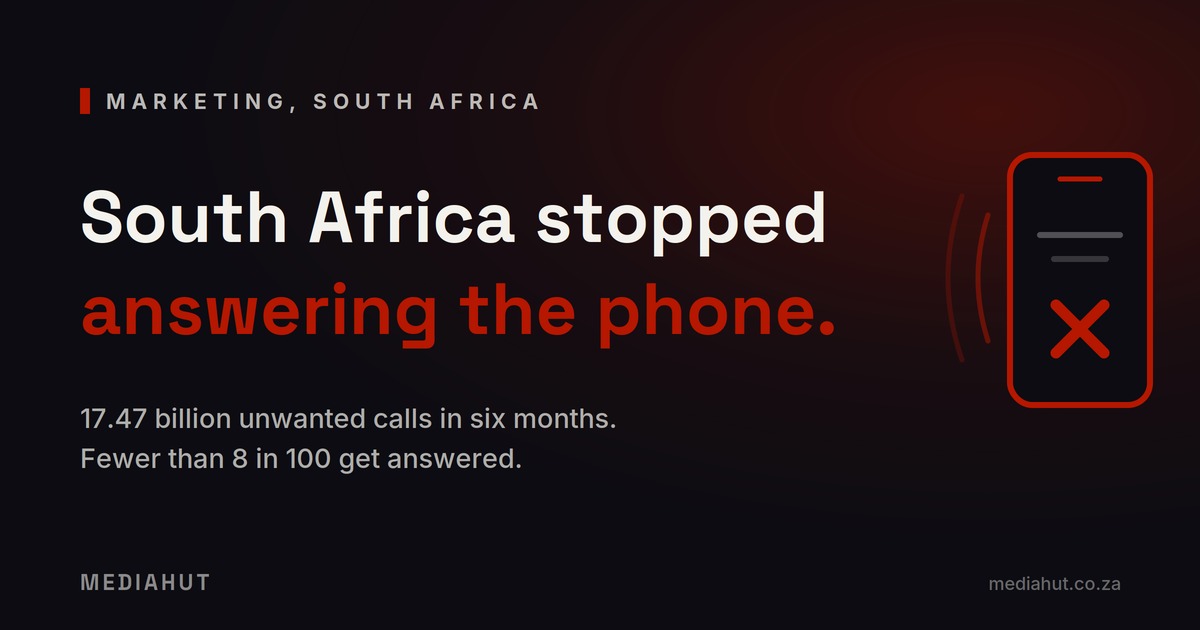
Truecaller’s latest report puts it at 17.47 billion spam calls aimed at South African phones between January and June this year. That’s up 25.2% on the same period in 2025. Spam messages ran to 3.71 billion, up nearly 59%.
The number that matters most for anyone trying to sell something is smaller and much more brutal. The share of identified spam calls that actually got answered fell from 10.2% to 7.8%. More than nine in ten go straight to a shrug.
Worth saying plainly: these are extrapolated market estimates from one company’s user base, not a national census. The direction is not in dispute though, and neither is what it’s done to behaviour.
Your legitimate call looks exactly like a scam
This is the part most businesses haven’t absorbed. You are not competing with other salespeople for a moment of someone’s attention. You’re competing with an ocean of fraud, and from the customer’s side of the screen you are indistinguishable from it.
Truecaller’s own framing of the local market is that this isn’t only fraud, it’s aggressive high-volume outreach that erodes trust in legitimate communication. Insurance calls make up roughly 14% of the spam reaching South Africans, financial services around 10%, debt collection about 6%. So if you’re a broker, an adviser or anyone who has to phone people for entirely honest reasons, you now start every call in a hole that someone else dug, wearing a costume you didn’t choose.
Caller ID spoofing made it worse, and generative AI has made scam conversations sound more convincing than they used to. The customer’s only sane defence is to stop picking up. So they stopped.
The law caught up in April
While everyone was ignoring their phones, the rules changed. In April this year the Minister of Trade, Industry and Competition published amendments to the Consumer Protection Act regulations. They set up a national opt-out registry administered by the National Consumer Commission, they require direct marketers to register, and they introduce cleansing, meaning you have to scrub people who have opted out from your database rather than waiting for them to complain.
There’s also a pre-emptive block, letting consumers refuse unwanted marketing contact before it ever happens.
Put the two together. Cold outreach now has a compliance cost attached to it, and it barely works anyway. That combination has an obvious conclusion for a small business with limited time and no legal department.
Being findable beats being loud
If you can’t reliably interrupt people, they have to be able to come and find you, at the moment they’ve decided they need what you sell.
That’s what the last two months of these posts have been circling. Google sends fewer visitors now, but the ones who arrive are closer to buying. A growing share of South Africans ask an AI assistant for recommendations and take the answer like a referral from a well-read friend. Almost all of them are on a phone. Every one of those routes has the same requirement: your business must be easy to find, quick to understand and possible to verify without talking to anyone.
That’s not a softer version of selling. It’s the version that still functions.
If you do still need to phone
Some businesses genuinely have to call people, and there’s a professional way to do it in 2026.
Earn the ring first. A WhatsApp or an email that says who you are and asks when suits, so your number is expected rather than suspicious. Book the call in the diary. Send a message immediately before it. Make sure your business number is registered and identifiable rather than showing up as a bare mobile with no name attached. And if someone doesn’t answer, one voice note beats six missed calls, because six missed calls from an unknown number is what a scammer does.
That’s not a growth hack. It’s just what respect looks like when trust is this scarce.
The bigger point
Interruption was always the cheap option, and it stopped being cheap. What replaced it is slower and more permanent. Be somewhere people can find you. Say clearly what you do. Give strangers enough proof that they don’t need to phone anyone to check. Then be easy to contact on their terms, in the channel they chose, at the moment they chose it.
South Africa hasn’t stopped buying. It’s stopped answering.
If people can’t find you when they go looking, that’s the thing to fix.